The Leap Takers
Stubbornness and resistance under pressure became Hume's and Trimble's common strengths in withstanding attacks from inside and outside their respective political camps.
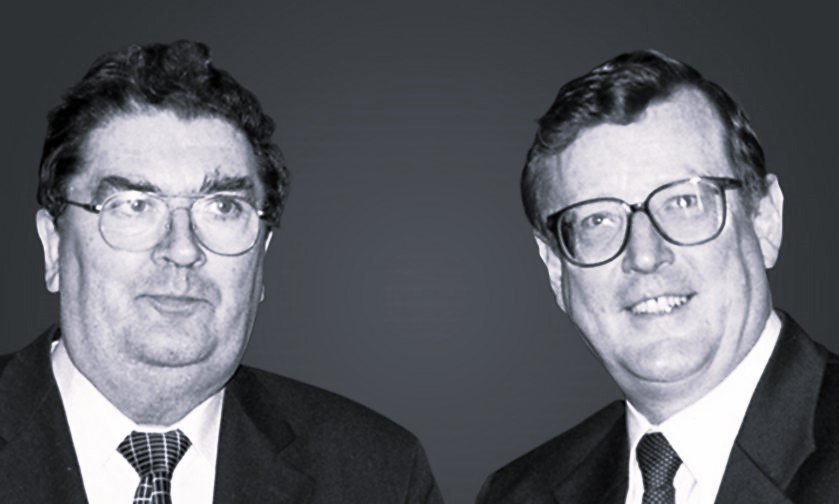
John Hume: The Persuader, by Stephen Walker, Gill Books, 432 pp, £25, ISBN: 978-0717196081
David Trimble: Peacemaker, by Stepehen Walker, Gill Books, 464 pp, £25, ISBN: 978-1804581926
Commenting on the presentation of the 1976 Nobel Peace Prize to Mairead Maguire and Betty Williams, the co-founders of the Women for Peace movement in Northern Ireland, Kenneth Kaunda, the veteran resistance leader and president of Zambia wrote that unless the movement the two Nobel Laureates led could bring about political reform they would not achieve their aims. While he shared their attachment to the philosophy of non-violence epitomised by Mahatma Gandhi, Kaunda’s work for freedom and peace in Africa had given him a tough and realistic perspective on the challenges. History proved him right, for despite the efforts of their movement to bring about a peace in the 1970s, Northern Ireland would suffer another two decades of violent political conflict before the political reform that Kaunda identified as essential was achieved in the 1998 Belfast/Good Friday Agreement – the outcome, not of protest marches by civil society but of long and complex negotiations between political leaders.
Creating the context which made the Good Friday Agreement possible involved many political and civil society activists, and others, but when the Nobel committee considered how to recognise its achievement they rightly decided to award the 1998 Nobel Peace Prize to two key political leaders – John Hume, who founded and headed the Social Democratic and Labour Party (SDLP) and was the pre-eminent political leader of Northern Ireland’s Catholic nationalist community, and David Trimble, the leader of the Ulster Unionist Party representing the majority in the Protestant unionist community. As George Mitchell, the former US Senate majority leader, famously observed, ‘[t]here would have been no peace process without John Hume and no Good Friday Agreement without David Trimble’ – a sentiment widely shared across the community divisions. Despite the ups and downs of political life, the agreement has survived, and nearly thirty years on the violence has not returned.
Given that the agreement is one of the few peace settlements across the globe that have lasted a generation it is worth learning as much as possible about what was required to bring an end to the seemingly intractable violent political conflict in Ireland and exploring whether there are lessons for ending other conflicts.
There is general acceptance that ‘leadership’ is a significant element in delivering a negotiated settlement and so studies of the key leaders involved would seem to be a useful starting place. However, like many of the generation that built the Irish Peace Process, John Hume and David Trimble have both passed on without leaving much of a published legacy of their own lives and political careers. Fortunately, before all that generation that knew them slips into history, Stephen Walker, a highly experienced, award-winning BBC political correspondent has published two very readable companion biographies of Northern Ireland’s two political Nobel Laureates.
Walker was born and grew up in Northern Ireland and in more than thirty years of professional journalism developed relationships with the key players, reporting on the complex twists and turns of the ‘long and winding road’ to peace. He added to that experience a very substantial set of interviews with other participants in the Irish Peace Process who had worked closely with Hume and Trimble, as I did myself. Much interesting material emerges in his accounts, which show respect for what was achieved but still provide a useful critique of these two complex characters.
The Hume volume, with the strapline ‘The Persuader’, opens in 1992 with an exhausted and depressed Hume ready to ‘throw in the towel’, but being drawn back from the brink by his wife, Pat Hume, and his closest adviser, Mark Durkan. This introductory cameo introduces us to the pressures faced by John Hume, and later by David Trimble, and also flags up some key similarities and differences.
Pat Hume was a remarkable woman without whom her husband, John, could not have survived the emotional and physical stress of his political work. The same could be said of Daphne Trimble, David’s wife. Both were politically savvy, emotionally strong, and psychologically sophisticated in their handling of husbands who could both be described as ‘challenging’. Pat was a teacher and Daphne was a lawyer, and while the references to them are not extensive, they are important for anyone who wants to understand the two principal characters. After the agreement, the two women led the Northern Ireland Memorial Fund, supporting victims and survivors of the Troubles with practical help including educational opportunities for affected families. They travelled together, especially in the USA, raising money, promoting the Fund and continuing to make their own contributions to the healing process.
Northern Ireland is a small place, with a population of less than two million people, but the communities from which Hume and Trimble emerged were very different. Hume was deeply affected by growing up in Derry/Londonderry, close to the border between Northern Ireland and the Republic. The violent partition of Ireland happened not very long before he was born and his city, now on the border, was affected by a long history of violent conflict and social deprivation, the latter felt more in Hume’s Catholic nationalist community. David Trimble came from a modest middle-class home close to Belfast and found it difficult to accept that some of the claims from the Catholic community of discrimination were really justified.
Neither family was well-off, but Hume’s family knew real poverty when his father’s job disappeared, and he was unable to find employment again. Like many Catholic families they saw education as a route out of poverty and were assisted by the 1947 Education Act, which provided for compulsory secondary education for all children, funded by the state. John was a bright boy who did well at school and then went to Maynooth seminary. Here we find an important development which his biographer explores but cannot fully explain. Hume left the seminary and became a teacher rather than a priest. Did he just realise that a celibate life was not for him or did a minor infringement of the seminary rules persuade him that he was not keen to be ‘a man under authority’? The book leaves the question open but as I reflect on how he created and ran the SDLP, later turning down the opportunity to be deputy first minister, I wonder if being second-in-command did not suit him. He was a creative political thinker but operated mostly on his own. An example was how he worked to bring the powerful influence of Irish-America to bear on the British government to find a more equitable political structure in Northern Ireland and to recognise the nationalist aspiration for closer links with the South. Hume worked on his own here, and did not share the connections with his own party colleagues. In later life he seems to have made no ‘succession planning’ and the party never recovered after his eventual retirement. It would appear that for him the party was an instrument for achieving his own three key political aspirations.
His early experience of economic deprivation was foundational for his political philosophy. His father was more concerned about socio-economic disadvantage than Irish nationalism and John often repeated his father’s aphorism – ‘You cannot eat a flag.’ Initially therefore, he focused on improving the prospects for ordinary people by promoting credit unions throughout Ireland and establishing a local business producing and marketing smoked salmon.
Although the Humes were Catholic, one side of the family had Scottish Protestant roots, and one senses that this ‘mixed’ family background was important in his wish for peace between Protestants and Catholics. In his earliest political comments, published in two commissioned articles in The Irish Times, he wrote with a clear recognition of the disadvantage suffered by his own community but also a powerful critique of the nationalist leadership in the North, which he felt had failed his people by opting out of governance by abstentionism.
Perusing his early speeches, articles and broadcasts one finds that he seemed well-suited for a left-of-centre liberal party and when one emerged in 1970 in the form of the Alliance Party of Northern Ireland they unsurprisingly invited him to join. Jim Hendron, one of the founder members, is convinced that if Hume had joined, he would have become the leader. However, as with the priesthood, John had other ideas. Shortly afterwards he drew together a group of social democrat and labour activists – mostly Catholics – to form a party with an Irish nationalist agenda. While in the early years he was careful to speak in ‘cross-community’ terms, his nationalism became more emphatic over time and he adopted old nationalist tactics (like abstentionism) and language (‘the government is not our government’), partly as a result of frustration with the unionist failure to accept that the future could only be peaceful if nationalist aspirations had equal recognition. What was novel about Hume’s nationalism was that he always spoke about uniting people rather than territory. While traditional nationalism spoke of a ‘United Ireland’, Hume spoke of a ‘New Ireland’ where the divided people could come to live with respect for their differences. This new perspective became a crucial development in the years ahead as his analysis focused on developing new relationships between the people of the island.
Walker maps out Hume’s political development from that of an increasingly popular independent challenger of the old nationalist leadership to elected parliamentarian leading a new, more attractive and interesting nationalist party, and then on to the difficult process of combating the political violence of physical force republicanism and simultaneously creating a new political approach, attractive to the British and Irish governments, Irish-American opinion-leaders, and more progressive elements in the pro-British majority in Northern Ireland. The model he chose was the postwar European project, which brought together historic enemies to pool their sovereignty and collaborate on socio-economic development. He emphasised building relationships between communities rather than the unification of territory. It was an attractive proposition, and Hume was a successful political salesman. His focus on relationships, however, was ironic given that he was not himself an easy character with whom to relate. People who came to visit might find him chatty, but at other times he could sit for hours with a visitor without talking, enveloped in his own thoughts. He could also be impatient with having to bring others along with him. When he was convinced of his own analysis he tended to think that those who could not see it were being stupid. While his social democratic commitment to the betterment of the less well-off and his espousal of the European approach to enabling traditional enemies to live and work together were widely regarded as positive, his insistence on being the leader, his conviction about the rectitude of his own political analysis and his impatience with those who disagreed may seem to be serious criticisms. However it may well be that this single-mindedness and determination were absolutely essential to his ultimate success. This was most evident with his insistence on talks with the leadership of Sinn Féin and the IRA when no other politician would do so while their terrorist campaign was in full operation. He was criticised by many who saw his attempts to persuade one of the world’s most long-standing terrorist organisations to abandon its ‘armed struggle’ as a doomed pursuit. However he persisted against all advice. While we might like to believe that the person who is flexible, open to persuasion and tolerant of other views will win out, John’s imperviousness to alternative approaches or models and his remarkable tenacity were key to bringing about the necessary results.
There were similarities with David Trimble. He was more affected by the constitutional anxiety of his community than by socio-economic deprivation, though this also affected many unionists. He was more preoccupied with the possibility of the British establishment abandoning Northern Ireland, as it had repeatedly done to other pro-British communities as the empire dissolved after the Second World War. In the early 1970s, when he was a rising star in the academic law department at Queen’s University in Belfast, he associated himself with the minister of home affairs, Bill Craig, who was strongly opposed to the civil rights movement and to campaigners like Hume. Craig banned civil rights marches, defended robust police action and appeared to be sympathetic to some paramilitary activity on the unionist/loyalist side. Trimble agreed with him and the sub-title for this book about him – Peacemaker – would have seemed a most unlikely description at this time and for much of his political career. In retrospect there was an interesting indicator of the future in his short and unsuccessful involvement with Craig. Unexpectedly, in 1975, Craig, with Trimble’s support, developed a proposal for a voluntary coalition government between unionists and nationalists. It got little support and effectively ended Craig’s career as well as that of his young protégé. Trimble appeared to have lost out all round. His dalliance with more radical unionists and loyalists ensured that he did not get professorial and other promotions at the university despite being eminently suitable while it also marginalised him politically so that he was not selected for senior positions in the Ulster Unionist Party. Opportunities only came many years later after much patient work at the local level and the passing of a generation of unionist leaders who had failed to deliver a political settlement. Part of his problem was that he was not very ‘user-friendly’. He was often described as being ‘on the spectrum’ – that is to say he showed autistic traits – single-minded in his interests and uninterested in making ‘small talk’ and participating in the social engagement expected at drinks parties and party events. He was neither a philistine nor a puritan, enjoying fine red wine and a night at the opera, but nor was he a socialiser.
On the surface, Hume and Trimble did not look likely to be collaborators and did not even appear to like each other. While Hume would speak in grandiloquent, flowing paragraphs about social democracy and the European project, Trimble, also well-educated, intelligent, and articulate, would focus on the details – the constitutional legalities – interpreting history through the lens of pro-British conservatism. Hume was determined to raise the minority Catholic community to an equal status with the majority unionists and to open the door to increasing collaboration, and eventually unification, with the rest of Ireland. Trimble wanted to maintain and strengthen the constitutional relationship with Britain and saw the relationship with the South as a threat. A ‘details man’, Trimble’s speeches were full of legal and constitutional arguments. In addition, if talking with terrorists could bring about peace, Hume was up for it. Trimble was only prepared to do it if it was on the unionist/loyalist side. He would not under any circumstances engage with the republicans in Sinn Féin and the IRA.
So how was progress made? Walker describes how both men became convinced that political stability and the protection of their differing constitutional aims required an end to terrorist violence, and both appreciated this would require talks with each other and at least some of those who supported the campaigns of violence. They appreciated that political structures which gave guarantees to each side were necessary, but perhaps most importantly, when they became convinced of a political analysis and approach, both had extraordinary tenacity. Hume was often attacked for his views and his talks with the Sinn Féin and the IRA, and his life was at risk from violent groups on both sides, but he was determined to continue. Trimble was more often under pressure from his own party as the unionists became increasingly deeply divided. He experienced extraordinary personal abuse and threats. The stubbornness and resistance to pressure that both men exhibited might, one would have assumed, have been problematic, but instead they became strengths in withstanding attacks from inside and outside their own political camps.
One weakness Hume and Trimble shared was their belief that if they negotiated a settlement that ended the violence and instituted a new power-sharing government with cross-border structures, a grateful population would ensure that they and their parties were supported to stay in government. Neither could quite believe it when the voters abandoned them in favour of the more hard-line unionist/loyalist and nationalist/republican parties. It is however a truism that voters do not support politicians for what they have done but rather for what they expect they may do in the future. Churchill after the war is a good example and one suspects that while they too were abandoned by the voters, history will not abandon them. These excellent companion volumes make compulsive reading for anyone who wants to understand how courage, creativity, stubborn tenacity and timing are some of the key leadership qualities necessary to be a Persuader and a Peacemaker.
Donate ← Back to the current issue