A new poem by Vona Groarke
1.
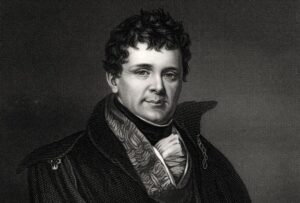
This evening is a rusty hinge, a page of greyscale, a blister pack of tail lights on the road. I’m keeping the fire in, for company, while my laptop gawps at me. I should be writing that essay about Wordsworth except, you know, he’s so annoying: I don’t want him here in my one armchair with the face on him that can only mean I’m doing it all wrong. That he thinks I’m about to ask him for money. That my poems are too wilful; my apples will rot; my fire draws badly; that I don’t understand; that this isn’t how you make ink.
I don’t want him standing in my kitchen like a flagpole in a storm. I’ve enough to be doing, with the fire to tend and the essay to not write. I’ll send him, I’ll have to, up the Ox Mountains with a cold mutton sandwich and a bottle of tea, let him strike iambs or rhymes or whatever from the sod with the heel of his boot. Odds-on he’ll startle a poem in the heather and want to bring it back to my notebook for me to pluck feathers from. But that won’t work, I’m wise to him.
The fire’s all a-go.
2.
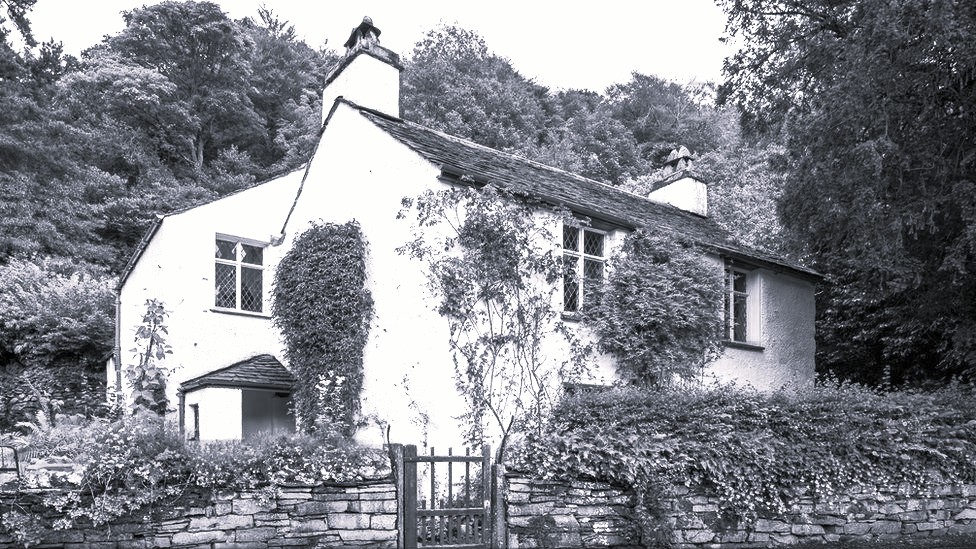
The forefinger of my right hand processes to the left the so many photographs I took away from Dove Cottage last year.
Door knobs, floorboards, window leading, sinks; wainscotting, fire surrounds, worn steps, clock; banisters, flagstones, coving, flues; or, for a signifying flourish, the finger nook in the window shutter hollowed out by years (from which I hoped to extract some words for an essay about ‘Poetry and Place’).
What I have instead is a salvage yard of photos of items with no discernible link, unless it’s the life I write through this and that, that I’ve no right to.
So hard, sometimes, to find between the slats of words a single fleck of light to lift on a licked forefingertip, to put in a pocketbook for later, to fail to find again.
3.
– A Found Poem taken from entries in the Journals of Dorothy Wordsworth, 1802
A hard frost. A grey morning. Mild warm rain. Walked to Rydale for letters. Tea with the Miss Cockins. Gathered mosses. Graving peats. Clapped and starched small linen. William not very much tired. We walked on Butterlip How under the wind. Had the mantua maker. A broken soldier. Moonlight. Headache. Snow. We walked in the evening to Ambleside. After dinner I read him to sleep. Worked at unripping. Gizzards and mutton. Rhubarb and gooseberry pie. Copied the Leech-gatherer for Coleridge. Finished the mattrass. Pulled a basket of peas. Helped Aggy Fleming to quilt a petticoat. William added a step to the orchard steps. Bad news of Coleridge. Feasting with silence. Coleridge changed his clothes. The moon had the old moon in her arms. My heart like a vision to me. At breakfast Wm wrote part of an ode. Got mullens and pansies. Glowworms. Toothache. Ragman. The Pedlar. Tea. Walked backwards and forwards. Took down his stanzas. We sate in the sun. We sat in the orchard. William heard me breathing. The stitchwort is fading. We dined and then William went to bed.
4.
I give up.
5.
I can’t. There has to be possible some resolution, a way through. To bow out is to leave suspended what I’ve got so far, which might be fine (every poem proposing the terms of its virtual suspense), but inefficient, wouldn’t you say?
I need to decide if my issue is with subject or with form: for a rope to work as a noose it needs firstly to be a rope.
What noose is this? The noose of my prosaic opinions? My very own staid news?
I should come with my two arms full of white lilac to lay down at your door.
6.
Yours is a brass door
four men high
flapping loose on its hinges
on a hunkering ship
out in a storming sea.
Mine the need
to get through it
somehow.
I am counting intervals
on my fingers.
I might as well
count out the sea.
What is the peace
I can make with you
who sits in shadow
who walks by moonlight
who always comes home?
There now. Quietude.
Hearthside. Quell.
The fire has no doors in it
and the words, no squall.
You could give them sixpence
on the road, they’d Thank You
Very Much. And forget you
as soon as you’re gone.
Donate ← Back to the current issue