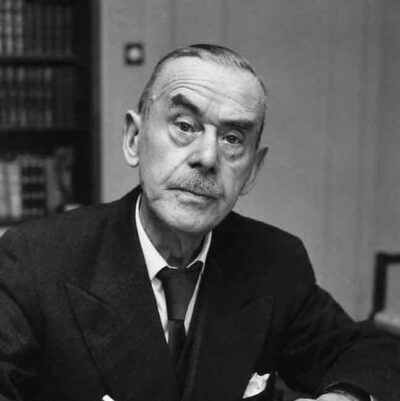
In May 1911, a few months before Gustav von Aschenbach first became a figment of his pen, Thomas Mann was staying with his wife and brother Heinrich on the wooded island of Brioni on the Istrian peninsula, holiday haunt of the Habsburg monarchy. Moving the holiday across to the other side of the Adriatic was not yet in prospect, but a disrespectful countess was disturbing dinner with her late arrivals and early departures. The irritable Manns had to stand up to defer to her grandeur and when enough was enough they took the ferry to Venice instead.
Mann insisted that Death in Venice was rooted in many real coincidences. Accordingly, starting in Munich, it takes a detour to Pula, the nearest port to Brioni, before establishing Aschenbach on the Venetian Lido. Still, Mann’s admission seems deliberately to lead the reader off the real, symbolic track of the story. Aschenbach in Pola, then an Austro-Hungarian military port writing its name in Italian, was suffering from a lifetime of excessive self-discipline. He disliked his fellow guests but it mattered more that Pola did not give him ‘the right relationship to the sea’. In fact the beaches near Pula are blissful small coves, with turquoise water lapping at low rocks. But for Mann their paradisical aspect was less suited to fevered imaginings than the flat, faintly mysterious expanses of the Lido. The Pula detour was useful though because it entailed the menacing ferry journey. Disconcerting, deeply undermining of his self-esteem, Aschenbach’s three-and a half hour journey on a dirty old Italian-built steamer, where clots of soot landed on deck and the waiter wore a grease-stained jacket, redoubled his earlier waking nightmare in Munich’s North Cemetery. The writer whose art depended on self-discipline was rattled. At the Lido’s Grand Hôtel des Bains he might recover his composure.
The irksome aristocrat at Brioni perhaps reappears in the much later story ‘Mario and the Magician’ (1930). There the action, set in a south Italian coastal town, picks up when a well-heeled German family is forced to change hotels because an Italian countess is misbehaving. That move – once again a boon for the novelist – brings them into closer touch with fascistic events and propels the action on. ‘Mario’ of course was another tale of moral undoing, now intermingled with the political undoing of a continent, whereas the Venice story, when Mann was still ‘unpolitical’, explored one man’s unravelling.
The ferry these days is a motorised catamaran with no murky quarters below deck and no in-seat service. But before I take it let me first recall that Mann heard of the death of Gustav Mahler on May 18th, 1911 while still in Brioni, and the passing of a great artist, whom he declared ‘expresse[d] the art of our time in its profoundest and most sacred form’, inspired both Aschenbach’s first name and his physiognomy. Luchino Visconti’s 1971 film Death in Venice would reimagine Aschenbach totally through Mahler’s sickly, frenetic vision of beauty and tragedy. Its visual and musical impact in the anglophone world makes it hard to come to the 1912 novella afresh.
But to begin on that track, in this story of a grand public personality disintegrating while, not far distant, the Austrian empire was also collapsing, Mann was not quite as unpolitical as he believed. It’s a small but telling point when Aschenbach considers what ‘outwardly holds together the vagaries of good behaviour’. When he decides, disingenuously, that dressing for dinner will do the trick we are not supposed to take him seriously. This is an age of decay. But also of enchantment. He experienced empire, I believe, and I will include here the Prussian empire, as a babble of voices. In Buddenbrooks (1901) he revelled in an early nineteenth century Lübeck – his native city — where the upper classes trading across the Baltic spoke either French or the local Plattdeutsch. The language of Goethe – Hochdeutsch – was an effort. Even where the educated class spoke high German it was often endearingly aberrant to Mann’s ear, with distorted vowel sounds, unfamiliar stresses and peculiar choices of vocabulary. But that was his point. Language was not uniform and nor, to draw the underlying political conclusion, was human nature; nor were the cultures which empires and nations and older class structures had gathered under their yoke. Mann grew up listening to, and relishing, an alternative diversity audible in the air.
Aschenbach was born in the easternmost Prussian province of Silesia, where Polish was commonly spoken, and it was on an early memory of that language that he could call when he first heard, across the Lido’s eerily flat expanse of sand, the name ‘Tadzio’, pronounced by his family and friends. He heard it as ‘Tadzioo’ and that long-drawn out oo-sound, the vocative of the familiar short-form of Tadeusz, was what really got under his skin, goading his precarious hold on a civilising normality. The novella would repeat that -oo in the cannibalistic frenzy engulfing his mind on a night close to his final breakdown. The sound had no place in the cultured language in which Aschenbach had made himself an exemplar, through literature, of decency. Mann had in common with Aschenbach that for all his secret doubts about his worthiness to fulfil that role, and because of them, he depended on cultural formality – and indeed on hochdeutsch – to hold his personal life together. The grammar and the correct delivery of formal language, in which Aschenbach and Mann were masters, reinforced the high bourgeois civilisation they needed to shelter them from their own wilder longings. The interplay of vague, faintly dehumanised, alien vocables in the seaside air brings us very close to how Mann’s intensely linguistic imagination worked. He loved what he imagined but he was also afraid of where it would take him.
In 1911 he too was a distinguished German visitor at the Grand Hôtel des Bains, working on small projects between trips across the lagoon to piazza San Marco (‘the most astonishing landing station’). It was on the hotel’s headed notepaper that he began writing his ‘Auseinandersetzung mit Wagner’, a short essay which made him reflect, with Nietzsche, that a man who could write Tristan, an opera of total erotic abandon, knew how frail the bourgeois moral order was. A trigger may have been that Wagner died in Venice in 1883.
Today the Grand Hotel is a solid art nouveau building dating from 1900, with 180 bedrooms and extensive grounds. The elevation facing the sea has no balconies and it has a townish air. Alterations from before it closed in 2010 have not improved it. Very recently, however, developers have seized on Mann’s story. Drawing on it to add value to the Lido, they have announced they will restore the establishment to its former glory. They are mindful that Aschenbach stayed there, as vital an occurrence in our minds as if he had been a real person.
Venice was afflicted by cholera during Aschenbach’s visit, just as it had been in 1905 when the Manns were first there. Aschenbach should have left but didn’t because he wanted to stay near the boy. One afternoon when perhaps the disease was already making him weary, he sat at his second-floor window scanning the beach for Tadzio. He descried a head and an arm that was, far out to sea, rudernd – rowing – . How could that be, queried my editor. Switching from text to actual location I could immediately see the answer. The Lido is so flat, and the sea so shallow, that the beautiful Polish boy would have had to wade out to swim. He spotted him still not afloat, scooping the water back as it reached his chest. Still he looked very far from the shore. They called out his name and – happily for both parties watching him – he came running.
Mostly Aschenbach rented a capanna on the beach. That Lido speciality is a rectangular beach hut normally made of heavy canvas with a front awning that, at the summons of the beach attendant, can be raised on two poles to extend the space. It makes a perfect viewing platform for the sea, although ‘platform’ is misleading, because the remarkable view from the long, almost militarily disciplined rows of capanne is, once again, totally flat. Your eye is level with the water and, yes, with the definition either side that comes from each beach hut’s limits, and the shade afforded by its canopy, you the viewer are as if taking a photograph of the water’s edge. Even more striking is the feeling that you are inside a box camera – which may help to explain the mysterious tripod on the beach at the end of the story, its putative camera operator having vanished in the moment Aschenbach died.
But I wonder if Mann didn’t also encounter, as I did, photographers snapping beautiful figures emerging from the sea. Aschenbach noted that the sea was ‘the backcloth and foil’ to a grand human spectacle. In Buddenbrooks a favourite Mannian reference was to Venus Anodyomene, Venus Rising from the Sea, painted by Boticelli, Titian and many others. I happened to see a lovely Roman miniature of her wringing her hair in Pula, and, a few hours later, I was so entranced by the sight of a black woman and her brother taking turns behind the lens that I strode over and quietly told them they were the most beautiful people on the beach. It was meant to be a friendly, un-creepy overture and it worked. They lived in Udine, a two-hour drive away in Italy, and were originally from Cameroon. The beautiful posing happened again at the Lido, with a woman posing for a male photographer on one of the serried ranks of short jetties jutting out into the water. Less impressed, I didn’t approach them but yes, there they were making use of the Adriatic as a ‘backcloth and foil’. Certain seasides – ones with whom the artist in all of us has the right relationship — have long since become the scenario of fashion shoots and poses for Instagram. Only Mann had the power to ask the real question. Set the beauty of the near-naked human body against an elemental backdrop of sand and sea and sky and you may end up wondering what fleshly human culture amounts to, as infinity beckons. You may feel pessimistically that it too will soon dissolve. But then perhaps that will make you want to hold on to it as most precious.
I had the idea I would follow Aschenbach through the backstreets of Venice, over the prettily arcing bridges, hiding now and again in case he caught sight of me, just as he did when he followed Tadzio. Re-reading how in the end, perspiring and reddening, he risked total self-humiliation, I wondered whether Mann wasn’t familiar with Stendhal’s De l’Amour, in which the secret lover thinks that if he dyes his hair green his beloved won’t recognise her hapless stalker. ‘He broke out in an unpleasant sweat. His eyes gave up on him, his chest felt tight, he had a fever and the blood hammered in his head. He fled the narrow commercial passages over bridges and into the alleys where the poor people lived; there beggars accosted him and the evil stench from the canals made it hard to breathe.’ Mercifully Venice is much cleaner than it was in Mann’s day.
On piazza San Marco the site of the one-time Thomas Cook office eluded me. Aschenbach went there because he felt he could depend on an Englishman to tell him about the disease he was well aware of but which the Italian authorities were trying to hush up. ‘A well-dressed Englishman, still young, with a parting in the middle of his hair, close-set eyes, and of that type so constituted in the depths of his being to be trustworthy that he could only ever seem alien and peculiar in the disingenuous south … in his decent and pleasant tongue … told the truth.’ Once again Mann admired a voice.
On his behalf I tuned in to Croatian and Polish on the ferry, and heard many varieties of Venice-bound German that would have caused him to raise an eyebrow. ‘Ich bitte Sie, liebe Gäste, diese App downzuloaden.’ App pronounced ‘Epp’. Downloaden turned into a German separable verb. But then a cultural world where norms have vanished and nothing is regulated, brings with it, for instance, the freedom to be openly gay. Mann would have emerged as a different writer in our time. In his own he was still partially hiding, enjoying, as a kind of displacement indulgence, the wicked things people did with standard speech.
For want of a room on the second floor at the Hôtel des Bains, I stayed at the nearby Excelsior actually right on the beach. Built in 1908 in an exorbitant orientalising style, it was the place where Aschenbach walked to, along the promenade, when he took his carefully measured exercise, and where in a definitive moment in the story, when he summoned all the reason he possessed and tried to leave the disease behind, his luggage was wrongly despatched to Como. Looking for any excuse to stay close to his beloved boy he triumphantly turned back from the railway station and, faking his embarrassment, dissembling polite concern that he no longer had the right clothes to dress for dinner, he restored his old routine. When the errant trunk finally returned, via the Excelsior, he unpacked and filled with his possessions all those cupboards in hotel rooms that travellers usually ignore. He was never going anywhere else.
At the Excelsior I became one of those visitors to ‘the kind of place that everyone chooses for a holiday’, and though tastes have changed since Mann’s day, there I was still wandering down to the beach in a white cotton robe just as Aschenbach remembered his fellow clientele, and availing myself of the hotel’s exclusive boat service to San Marco. (Aschenbach noted the Excelsior’s ‘private canal’.) Outwardly Mann was a wealthy, conventional European-minded German who stayed in the best hotels, also in fashionable Brioni, and had conservative taste. The grand bourgeois framework sheltered him from his unorthodox sexuality. He leaned on the feeling that the Grand Hôtel provided ‘a limited space, everyone following the same order of the day’. I think he experienced just what Freud set out to half-heal, namely those painful inner conflicts nurtured by an over-regulated society. But Freud didn’t really have solutions, just ways of perhaps bringing some relief, and nor did Aschenbach. He didn’t know what to do. His gay trouble made him lonely. ‘Loneliness promises something unique. It is an openness to chance – disconcerting and beautiful. A poem is like that. But loneliness also runs the risk of inviting experiences that are perverse, distorted, absurd and forbidden.’ That was why Aschenbach had to die.
Liberal European society today is so relaxed in sexual matters, and in the sartorial standards that Mann often used as a metaphor for correct behaviour, that newer generations may wonder what Aschenbach’s dilemma was. The only contemporary taboo is paedophilia, against which, yes, in his mind, he offends. The boy is fourteen. ‘For how can a man pass muster as an educator, whose innate, natural and unchangeable orientation is towards the lower depths?’ he had Socrates ask on Aschenbach’s behalf. But the most our hero actually did was to make himself a stalker, and when the family warned Tadzio off he was deeply embarrassed by his own compulsions.
The sexual tangle, and of course the fate of a Germany that succumbed to Nazism, is why most postwar critics preferred to follow the trail of how Mann became a political rather than a confessional writer. The whole world listened when after 1945 he spoke of ‘the good Germany gone astray’ (very close to how he had described himself in the 1903 novella Tonio Kröger as ‘a solid citizen gone astray’) In truth the political was never as alien to him as he suggested in Confessions of an Unpolitical Man (1918). Aschenbach was acutely conscious of ‘the consensus between the writer and the contemporary fate of his people and his country.’ Mann made him an exemplar of Prussian discipline tense to the point of impending self-destruction. With his political insight growing from understanding tensions in his own psyche, the 1912 novella was still a work of remarkable foresight. But then all his work, from the monumental Buddenbrooks to the terrifyingly intellectually intense Doctor Faustus, where the composer Adrian Levekühn (Adrian Live-Dangerously), an amalgam of Nietzsche and Schoenberg, went mad, told stories of cultural decline and fall. In that great novel of 1947 German classical music also died, inextricable from the contemporary political nightmare. Highly cultivated Germany was, in Mann’s fiction, let down over and over by the beauty it which it had religiously believed.
In Death in Venice Mann defended the discipline of high art, even while conceding that art’s essential tool, emotional manipulation, had too much in common with the rhetoric of political agitators and popular crusaders to warrant being considered noble and pure (as the classicising writer in him, and Aschenbach, would have wished). Going through the text it was a revelation to me how much he distanced himself from Aschenbach and how much his irony was deployed to avoid that manipulation in his own storytelling. Aschenbach, whose career was dedicated to ‘fighting off the sleazy and popular’ particularly despised the Neapolitan entertainers engaged by the Hôtel des Bains to divert the after-dinner crowd with sexual innuendo and music straight from the heart, and yet, tragically, we suspect he couldn’t help being drawn in.
I think if Mann were here today he would want to plead that not all high culture be deconstructed as manipulation in pursuit of power. He would cry: leave us some high-minded beliefs! Let us still believe in a good human nature and a benign political spirit! But his great translator into English, Helen Lowe-Porter, thought him politically naïve. She wrote to him: ‘I wondered if you do not move in too rarified an air … for the necessary ingredient of cynicism to find enough place in your political outlook.’ To this, in their correspondence of 1937, she added to a friend in 1942: ‘He has such a good heart … I do wish he knew more.’
The 1911 story ends with Aschenbach out of his capanna, having moved his chair ever nearer to the boy – ever nearer to the idea of consummated love, Tristan-style – and to the sea – self-abandonment and infinity. In Venice they celebrate a ‘Marriage to the Sea’. Every year the Doge used to go out to the Lido to drop a gold ring into the sea. Perhaps there’s an allusion there. But to link Aschenbach’s end to Plato’s Symposium reaches deeper. If beauty and truth – and our love of them – collapse, all then that is left to us is the formless absolute to which we all return.
28/10/2025
Lesley Chamberlain’s new translation of Thomas Mann’s Death in Venice (Pushkin Press) will be published on January 26th, 2026. A separate volume, Thomas Mann Love and Enchantment: Three Stories, will also appear.
Donate ← Back to the current issue