A century has now elapsed since F Scott Fitzgerald’s The Great Gatsby was published. Its author had had high hopes for it, especially after the embarrassing failure of his play The Vegetable. Not only did he want this new book to be a commercial success, he also hoped it would lead to his being taken seriously as a writer, an artist like Eliot or Joyce, not just a hack who could turn out slick short fictions for the Saturday Evening Post. In the event, most American critics were polite but underwhelmed. (Less restrained was Fitzgerald’s UK publisher, Collins, who refused to put it out on the grounds it would kill whatever reputation its author had.) Commercially, the book did well enough, earning its author some half a million dollars in today’s money, but this was a disappointment compared with his previous books. Moreover, it quickly fell from view. In 1940, the year of Fitzgerald’s death, it earned him barely two dollars in American royalties and absolutely nothing anywhere else.
Far from marking the start of a new departure for Fitzgerald, Gatsby initiated a period of low creativity and increasing self-doubt. It would take the author the best part of a decade to complete the follow-up, Tender is the Night, only for it to meet the same so-so reception as its predecessor. All in all, the 1930s were a dismal decade for Scott Fitzgerald, a time when his reputation plummeted and he lost that previously golden touch that had allowed him to dash off highly marketable short stories, many of them earning the equivalent of a good annual salary. Worse, though he had been paid a small fortune for his fiction, he had spent a great deal more, leaving him with debts, not assets, not even a house, and this, just as his costs were mounting. For the rest of his life, he would dutifully pay for the care – it was considered care by the standards of the time – of his troubled wife Zelda and the school fees of their daughter Scottie, even if this meant living on a pittance. Finally, alcohol was taking its toll. (Fitzgerald was, by all accounts, a tiresome drunk, given to fratboy pranks like boiling guests’ expensive watches in tomato soup, deliberately breaking whole sets of crystal glasses, and picking non-political fights with fascisti in Rome). Nothing seemed capable of arresting this decline, neither good writing (the Crack Up essays, the Pat Hobby Stories, the unfinished Last Tycoon) nor not so good (scriptwriting in Hollywood and an unwise foray into historical fiction). He did not live to see The Great Gatsby, in one of the most remarkable turnarounds in literary reputation, become, not simply canonical, but a firm favourite for the Great American Novel. It is today one of those books that just about everyone has heard of – even if they have not read it. And now it is a hundred years old.
The story is well known. Jay Gatsby, born Jimmy Gatz to wretched poverty, has a mansion on Long Island, though on the less fashionable West Egg side rather than the uber-chic East. East Egg is the height of fashion because that is where the old money people live – old money being money from far enough back that the ways in which it was earned are no longer immediately traceable. West Egg is for the nouveaux riches. Gatsby claims to be old money but the real upper class can easily sniff him out. He has made his pile quickly and dubiously, though not for himself so much as to win over the authentically patrician Daisy Fay whom he dated once, some five years earlier, when he was a junior army officer. Infatuated, Gatsby has made a Faustian pact with the underworld of dodgy dealer Meyer Wolfsheim that has made him rich. He settles on West Egg to be right next to Daisy, married now to the rich but boorish Tom Buchanan. Gatsby’s regular and lavish parties are thrown in the faint hope she might show up. Enter Nick Carraway, a mid-westerner in town to try his hand at the bond business. Helpfully, he knows Tom from Yale and is Daisy’s cousin, at some remove. Through Nick, Gatsby at last reconnects with his muse and they begin a brief affair. This culminates in an ugly, inebriated showdown in the Plaza Hotel following which Daisy, driving Gatsby’s car, runs over and kills Tom’s mistress, Myrtle Wilson. Gatsby takes the blame, which is fortuitous since, separately, Tom and Daisy have agreed to pin it on him anyway. Tom directs Myrtle’s angry husband, George, to Gatsby’s mansion, where George promptly arrives and shoots him dead. Nick, who has narrated the story, sees that the old money people – who are more or less his own people – are ‘a rotten crowd’ and that Gatsby is morally way above them, if still some way below Nick himself. Carraway returns to the mid-west, but not before delivering one of the best-known closing paragraphs in all fiction.
A handsome centennial edition from Cambridge University Press with annotations and excised sections is an obvious highlight in what has seemed to me an otherwise subdued anniversary. It includes a sharp introduction by Sarah Churchwell that draws, in part, on her previous, and equally impressive, Careless People, challenging several misconceptions about the book – that it is a novel of the Jazz Age for example, or that it is about bright young party people. In Gatsby, the main events take place in the summer of 1922, as far from the Jazz Age proper as, say, 1962 is from the Summer of Love. The look and atmosphere of 1922 would have been a lot closer to the 1910s than to anything we would regard today as quintessentially 1920s – no one danced the Charleston in 1922, for example, though they may have shimmied, and flappers were a year or two in the future. Change was happening in areas like music and architecture but only a few – like Fitzgerald’s friend Edmund Wilson – were starting to notice. There was cinema, musical comedy, or the New York skyline, which in 1922 would have looked fresh and inspiring. And jazz. Even in 1922, a few years shy of the jazz age proper, jazz was already being thought of as more than just entertainment. Gatsby is sufficiently up to speed – or credulous, or pretentious – that he has Vladimir Tostoff’s Jazz History of the World, previously a hit at Carnegie Hall, performed at one of his parties. By the start of the twenties, cars were sufficiently commonplace that, as Churchwell notes, New York required its first set of traffic lights, which became, for a time, a talking point and a sight to see. Finally, there was prohibition, introduced just two years before Nick and Gatsby’s fateful summer. To some of its advocates, at least, this was progressive too, a great leap forward in public health. The copious amounts of alcohol consumed during the novel are consumed illegally. Getting around prohibition is Gatsby’s racket. Or one of them.
Cars and alcohol are particularly important to the events of The Great Gatsby, but they also mark a social divide. Tom, the wealthy consumer of illegal alcohol can still disdain Gatsby, who is merely the law-breaking supplier. Both Tom and Gatsby are also part of the new and privileged car-owning class, at the top of it, in fact. But even here there is a caste divide. Gatsby’s yellow Rolls Royce (a ‘circus wagon’ says Tom) outs him as parvenu just as much as his pink suits and arch anglicisms. George Wilson, in contrast, merely services other people’s cars as part of his subsistence on the Eliotian ash heaps. He hopes, begs even, that Tom might sell him a car that he can fix up and sell on.
What is important in The Great Gatsby, says Sarah Churchwell, is ultimately not the time in which it is set, but whether Daisy will keep faith with Gatsby and the question of how far, and for how long, a person should chase a dream before it becomes an obsession. More important still is that, by saying something about a few Americans at a particular time, the novel manages to pose some sharp questions about the state of the nation in general. How free is it, this land of the free, and how open and inclusive? Is the WASP elite losing its grip? And should we worry? According to Churchwell, this was a side of Gatsby largely overlooked until the late 1930s, when its ‘elegiac sense that America kept betraying its own ideals seemed considerably more persuasive’. The book, she says, explores the American Dream, around a decade before people had begun to think there was such a thing as the American Dream.
There had been significant immigration to the United States in the nineteenth century, when the country was expanding territorially and economically and needed much more labour than American birth rates could supply. This prompted a kind of caste war between nativists – Americans who claimed or imagined descent from the original Anglo-Saxon colony – and the various newcomer communities. Immigrants and their descendants joined African Americans, Native Americans and Hispanic Americans as part of a diverse outgroup and underclass subject to formal and informal exclusion from political and economic power. By the 1920s, a few people who were immigrant-descended had managed to do reasonably well relative to nativist norms, but that was far from the general lived experience of immigrants (and even further from the lived experience of the non-immigrant minorities). An upwardly mobile few rose out of their community, sometimes through the expedient of formally disidentifying with it if they could get away with it – the original name anglicised, the ancestral religion abandoned etc. Thus Jimmy Gatz, whose name is either Polish or Ukrainian – becomes the comfortingly Anglo-Saxon Jay Gatsby. This limited social mobility could be used, by the elite, as evidence that the system was more fluid than was actually the case. And that was the American Dream.
The American Dream, by suggesting that upward social mobility is relatively straightforward and commonplace, was a kind of inversion of the noble lie in Plato’s Republic. The noble lie is required, Plato advises, because social mobility is in practice so uncommon a phenomenon that people’s expectations need to be managed down. They need to be told that the elite is elite because the people who comprise it are innately fitted for the role and that that innateness is almost always passed down, parent to child. There will be the occasional swan born among ducks, whose swan-ness will gradually reveal itself, but that is so exceptional as not to matter. The American Dream says instead that we can all be swans so long as we apply ourselves to the task, but that it is very much down to us.
One fact of reality (as Ayn Rand might have put it) an aspirant American dreamer might have noted as they pulled tentatively at their bootstraps in the early twentieth century is that advantages of wealth and status compound inter-generationally so that the relatively well-off and/or relatively powerful build an increasingly unassailable edge over the relatively worse-off and disempowered. And that is even before the two unmissable elephants in the room – gender and ethnicity – have been factored in.
Jimmy Gatz’s first attempts at moving himself up the social scale – that naive self-improvement schedule he sketched out on the flyleaf of a Hopalong Cassidy book – comes to nothing. The fatal flaw is the money he aims to save, presumably as start-up capital. Five dollars a week is the initial plan, soon amended to three. In 1900, five dollars a week – or even three – saved in an interest-bearing account for, say, seven or eight years, would have delivered a decent sum. But what child in Jimmy Gatz’s circumstances could have raised, let alone spared, the required subscription, every week for the foreseeable future? There follows the Dan Cody episode, where Jimmy is left a sizeable bequest from his late mentor’s fortune, only to be stymied by Mrs Cody. Fortunately, however, there was then a world war which would prove, quite literally, Gatsby’s making, indirectly enabling him to rise out of his caste, to disidentify. It is the sight of the demobbed Gatsby in uniform that inspires Meyer Wolfsheim to recruit him as his respectable front-of-house.
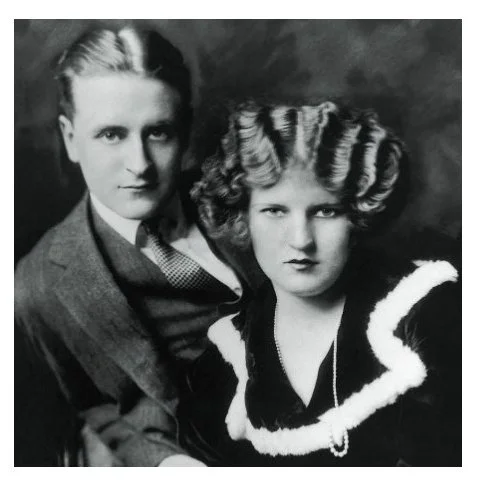
Scott Fitzgerald is a very autobiographical kind of writer. The Great Gatsby feeds on what would today be called his issues. He was Irish-descended on both sides, and Catholic too, at a time when neither of these was a particularly helpful thing to be, at least for the purposes of social mobility. Money was not the problem. There was enough family money to send him to good schools and then to Princeton. Nor was he luckless. Shane Leslie, late of Castle Leslie in Glaslough, and a priest, Sigourney Fay – both Catholic converts – were good mentors and role models. Leslie was especially helpful. He read through the first draft of what would become This Side of Paradise and, though he found it dreadful, sent it to Scribner’s with a cover note to the effect that Fitzgerald, by then in the army, was about to be sent to France where he would in all likelihood be killed, so maybe give him a break and let him down easy. As it happened, editor Max Perkins saw promise in the writing and took Fitzgerald in hand. The result was a bestselling debut, widely welcomed as the voice of a new generation and praised by Thomas Hardy among others. Fitzgerald was on the rise, from zero to hero, yet still the politics of identity worried away at him. He was nearly WASP but not quite, and at a time and place where that kind of near miss was as good as a mile. There was a family connection on his father’s side to the Confederacy that allowed him to pose as distressed southern gentry and, remarkably, this was considered a better thing to be than Famine Irish, which was his mother’s background. But it was a pose unlikely to have convinced where he most wanted it to, which was with the authentic (and dysfunctional) deep south family of the woman he would marry, Zelda Sayre. (Sally Cline, in her 2002 Zelda Fitzgerald: Her Voice in Paradise, notes the importance, in the Sayre household, of character and background over current financial status.) Fitzgerald’s hang-ups on account of his Irishness have been recently discussed by Patrick O’Sullivan Greene in a highly readable book, Gatsby: Death of an Irishman. Here, Fitzgerald’s Irish Catholic identity is depicted as a kind of private shame that has enabled him to make Gatsby so convincing a character: we can believe in him, this great interloper who has become, needs must, a great pretender.
We know that Gatsby is not all he says he is – that he was born rich, to old-money parents usefully deceased, that he attended Oxford, lived in Europe and elsewhere, had his heart broken and came home. Only the heartbreak is true. The rest is at best thereabouts.
The core myth – that Gatsby comes from old money – is quickly rumbled when Gatsby locates his alleged hometown, San Francisco, in the Middle West and then lets slip that it has taken him three years to earn the money to buy his house. Wait a minute, says Nick Carraway, did you not just tell me you inherited your money? ‘I did, old sport … but I lost most of it in the big panic – the panic of the war.’ But Nick, on a roll now (‘I think he hardly knew what he was saying’), asks him how he earned it back. Gatsby’s first response is to lapse out of persona and snap that that is his affair, not Nick’s, but he quickly recovers, offering that he has done well in the oil business and pharmaceuticals.
The Oxford story fares no better. Gatsby’s only proof that he has been there, aside from his insistent and affected ‘old sport’, is a photograph that might show him anywhere with anyone but which he claims was taken at his college and in the company of, among others, the Earl of Doncaster. (As it happens, the Earl of Doncaster is a subsidiary title of the Duke of Buccleuch, from whose line, according to Nick, the Carraway family is perhaps descended. Thus does the Carraway myth touch gently on the Gatsby myth.) If Wolfsheim believes the Oxford story – Gatsby, he says, went to ‘Oxford College’ – Tom Buchanan does not. Oxford, New Mexico, he sneers – what kind of Oxford man wears a pink suit? Gatsby, himself, in the pivotal Plaza Hotel scene, qualifies his story by saying he was there on a short course paid for by the US army, a postwar thank-you to its officers, and that he cannot therefore really call himself an Oxford man, even though that is more or less what he has been doing.
Gatsby’s military service is a different matter. He must have been an officer in the American army because it was only on account of his rank that he was able to meet Daisy on something like equal terms. The uniform transformed him, made him a credible patrician, at least until Armistice Day. But how did someone from Gatsby’s background become an officer? Fitzgerald himself had been an officer, but Fitzgerald had been to Princeton and the army, after 1917, was keen to recruit Ivy Leaguers as officers. It was a poor choice on their part as far as Fitzgerald was concerned. At Princeton, he had been a dismal scholar, lazy and undisciplined (though a superb writer of musical comedies, which might easily have become his profession). And as an officer, he proved no better – utterly incompetent to the extent that it was lucky that he never saw any actual fighting. That was the military career of the (relatively) privileged Scott Fitzgerald. What about Jay Gatsby? In 1917, the United States, having entered the war, needed to build a European-sized army and do so quickly. In the same way there had not been enough American newborns to deliver on industrialisation and manifest destiny, there were not enough Ivy League men to fill the hundred thousand officer posts that were suddenly required. As a result, there was no choice but to recruit beyond the elite. Officers would be selected on the basis of ability, which would be assessed by psychometric testing – the new IQ tests designed at Stanford by Lewis Terman. And that is presumably how Gatsby, along with many others from the wrong side of the tracks, ended up with a commission. They were commissioned from the wrong side of the tracks for the purposes of establishing the United States as a global military power on the clear understanding that, when the war was over and a global presence established, they would go right back to the wrong side of the tracks. This was an entirely time-limited outbreak of egalitarianism but it gave Gatsby the chance to pose as an officer and a gentleman and fall in love (or infatuation) with Daisy Fay. But only for so long as there was a war. Once the war was over, he was a demobbed officer (‘Mr Nobody from Nowhere’, as Tom puts it) and Daisy was again out of his reach.
Lieutenant Gatsby, at least by his own account, had a good war. He fought in the battle for the Argonne Forest, for which service he was promoted to major and decorated by every allied government, ‘even little Montenegro’. Is he lying, or at the very least, talking himself up? Wolfsheim, for what it’s worth, remembers that when he first ran into Gatsby he was in a major’s uniform ‘covered with medals’ but it is only the Montenegro medal that we actually see. ‘The thing had an authentic look,’ Nick tells us, which is not exactly verification. Not only is the authenticity of the medal left unsettled, the particular act of heroism that Gatsby claims earned him his promotion and his decorations sounds a lot like a conflation of the stories of the Lost Battalion and Alvin York, incidents that happened during the Argonne offensive and were widely reported, indeed romanticised, in the American press. If Gatsby had the type of war he says he had, would he not have been better received back in civilian life, and been better known and better thought of? It seems likely enough that Gatsby did not take part in the Argonne campaign and he may, more or less, give this away himself. The Argonne offensive began in September 1918 and yet Gatsby tells Nick that he had left his unit by June of that year. It could be that Gatsby, like Fitzgerald, was an officer who never got to the Western Front, for presumably the same reason, that the war ended before he got his chance.
If Jay Gatsby draws on how Fitzgerald saw himself – a bit of an imposter – Nick Carraway is possibly how the author would have liked to have been, born to the elite but something of an outsider too, casting his cold, midwestern eye on his east coast betters. All of the book’s best lines fall to Nick, that closing paragraph, of course, but also the following, unsettling capture of urban alienation.
I began to like New York, the racy, adventurous feel of it at night, and the satisfaction that the constant flicker of men and women and machines gives to the restless eye. I liked to walk up Fifth Avenue and pick out romantic women from the crowd and imagine that in a few minutes I was going to enter into their lives, and no one would ever know or disapprove. Sometimes, in my mind, I followed them to their apartments on the corners of hidden streets, and they turned and smiled back at me before they faded through a door into warm darkness. At the enchanted metropolitan twilight I felt a haunting loneliness sometimes, and felt it in others – poor young clerks who loitered in front of windows waiting until it was time for a solitary restaurant dinner – young clerks in the dusk, wasting the most poignant moments of night and life.
The text of The Great Gatsby is presented as Carraway’s written reminiscence, strengthening the bond between real-life author and fictional narrator. (It could be an error on Fitzgerald’s part when he has Nick remark that he has been writing rather than merely telling his memories of the summer before last but if that is so, it is a revealing mistake that makes the connection between author and narrator all the stronger.) Since Nick is writing, then Gatsby is all the more his selective narrative, crafted and considered. Can we trust him? He says we can, says he is one of the few honest men he has ever known. And of all the book’s patrician characters, he is the only one who is fair to Gatsby, open enough to give him a hearing. Moreover, though he sees through him, he keeps his scepticism to himself. It may be that something in Jay Gatsby appeals to his writerly imagination, or that they are both, in their own way, not fully part of the world of the Buchanans. Though Nick, by his own admission, did not approve of Gatsby in life, he respects him enough to pay him that one, parting compliment – that he is worth the entire Buchanan set put together.
Of all the novel’s characters, only Nick grows, sheds what he calls his ‘provincial squeamishness’. At the time of the main events, he is passive and suggestible. But two years later, when Gatsby, George and Myrtle are dead and he has got the measure of the whole ‘rotten crowd’ he is wiser and more assertive. Talking to Tom, he says, made him feel like he was talking to a child. But he shakes his hand all the same because it would have been ‘silly’ not to.
Nick’s father’s advice, with which The Great Gatsby begins, is that before you start to criticise someone, you should, in effect, check your privilege, for not everyone has had it as easy as you. And Nick has certainly had it easy. You do not get to Yale, not now, not then, without having the wherewithal behind you to cover the fees. And you do not enter the bond business without connections. Not in 1922 and probably not now. Tom, on the other hand, if he were to reflect on his status at all, would probably consider it an entirely appropriate outworking of natural selection. (In a previous time – up to around the second half of the 1800s – he would have thought it the consequence of divine will, or some such.) Part of his problem with Gatsby is not simply that Gatsby is an upstart who has wronged his friend Walter Chase and has an eye on Daisy, but that he is affronting this supposed natural order of things. Whatever ethical difference there is between the two is entirely in Gatsby’s favour. Tom drinks illegal alcohol even if he has no respect for the people in the supply chain; where Gatsby is romantic, Tom is proud of his infidelities, insisting that Nick come with him and see his ‘girl’; and shortly after this introduction, there is a drunken party that ends with Tom punching Myrtle in the face, breaking her nose. Finally, Buchanan has no qualms about setting Gatsby up for murder on the grounds that ‘That fellow had it coming to him.’
If Gatsby is anxious because the immigrant group into which he was born marks him out and holds him back, Tom frets, however implausibly, that the WASP elite that gives him his status is losing its grip, or rather is having its grip taken away. It is being taken by women who, in Buchanan’s view, ‘run around too much these days’, or by the likes of Gatsby, on the make, or by minorities in general. Seen through twenty-first century eyes, Tom is a kind of proto replacement theorist. He views himself as part of an imagined Aryan elite and does not want to see that elite depleted through social mobility and the end of everyday racism (‘next thing they’ll throw everything overboard and have intermarriage between black and white’ he says in the course of the Plaza showdown). ‘It’s all scientific stuff,’ he argues, citing a book he has either read or heard of – The Rise of the Coloured Empires ‘by this man Goddard’. This could be a reference to Lothrop Stoddard’s The Rising Tide of Colour Against White World Supremacy, which had been published by Fitzgerald’s own publisher, Scribner’s, in 1920 to good sales. It is a work of scientific racism, which is racism dressed up as science. Racism dressed up as science was entirely respectable in the 1920s, as was plain old-fashioned racism with no scientific pretensions. It may be that Tom is conflating Lothrop Stoddard and Henry Goddard. Where Stoddard argued for racial purity, Goddard advocated the need to guard against ‘feeble-mindedness’, which he alleged was to be found, disproportionately, among America’s immigrants. His research – based on over-generalisation from very small samples, which was virtually the house style for scientific racists – was later found to have been falsified, which was also more or less standard. Both Stoddard and Goddard used their respective cranks to oppose immigration and desegregation.
It would have taken some imagination in 1920 to see a ‘rising tide of colour’ in the United States or anywhere else. There was not a single African American in either the House or the Senate. There were no African American Supreme Court justices and all kinds of tactics, from brazen disregard for the rules to violence and murder were used, unpunished, to perpetuate African American economic and political exclusion in particular. The Ku Klux Klan is never mentioned in The Great Gatsby but the book coincided with its period of greatest influence, when it extended its support base north and had the run of a couple of states, including Indiana. Stoddard was a Klan member and provided it with an intellectual basis, and he would in a few years’ time be warmly welcomed in Nazi Germany and write sympathetically about his hosts.
Nick is more scornful of Tom himself than of the Goddard/Stoddard theory per se: ‘As for Tom,’ he comments, ‘the fact that he “had some woman in New York” was really less surprising than that he had been depressed by a book.’ Tom, the onetime football star with nothing to do all day save adultery and allowing the media to feed his fads and anxieties, has become a figure of fun. From a narrative and authorial perspective, what makes him ridiculous is not that he is a racist but that he is a ludicrous and highly suggestible one. It is unlikely that any of the others around him are any less racist.
Though Fitzgerald, like Nick, scorned the Lothrop/Goddard thesis in correspondence he was himself capable of crass, pseudo-scientific racism. ‘The negroid streak creeps northward to defile the Nordic race,’ he wrote of Europe. ‘Already the Italians have the souls of blackamoors … I think it’s a shame that England and America didn’t let Germany conquer Europe … I believe at last in the white man’s burden. We are as far above the modern Frenchman as he is above the negro.’
In Gatsby, he has Nick displeased at the sight of some African Americans (‘two bucks and a girl’) being chauffeured by a white man. Their ‘haughty rivalry’ ultimately makes him laugh and, having seen this sight and laughed at it, he reflects that anything is possible in these times, which is, in the end, a lot like Tom’s thinking. Fitzgerald here misses completely the significance of a private car in a country where a lot of public transport – a lot of public space in general – was segregated. And he misses too why black Americans might value a white driver who could read the road ahead for signs of racism.
Fitzgerald too tried to read the road ahead. The American future as he imagined it in 1925 – feminism, minority empowerment, anti-imperialism, new money replacing old – was not to his taste any more than it was to Tom Buchanan’s. Nor does it appeal to Nick Carraway, the book’s sole relatively honourable patrician. By the novel’s close, he has retreated back west. Having decided he prefers the upstart minor criminal Gatsby to the Buchanans and their type, he has, nonetheless, resigned the future to these amoral moneyed people.
The Great Gatsby is a conservative text for a society that at the time of its writing was too young and uncertain to have much to conserve. It captures a settler people still unsettled more than a century on, thrown back into nostalgia even as they press forward. For this it has remained relevant.
28/10/2025
Main Works Cited in the Text
F Scott Fitzgerald, The Cambridge Centennial Edition of The Great Gatsby, edited by James LW West III and Sarah Churchwell, Cambridge University Press, 2025.
Patrick O’Sullivan Greene, Gatsby: Death of an Irishman: F. Scott Fitzgerald and his search for identity, Wordwell, 2025.
Martin Tyrrell is the author of From Class War to Cold War: Orwell’s enduring socialism, to be published by Athabasca University Press in May 2026. He is currently editing Máirín Mitchell’s 1937 Storm Over Spain for republication in the new year.
Donate ← Back to the current issue