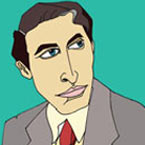

A Necessary Restitution
The English poets of the 1940s, sandwiched between Auden, Spender, MacNeice and the main poets of the 1930s and the later development of ‘the Movement’, tend to be overlooked today. The publication of a collected poems of one important figure, Terence Tiller, is very welcome.
Sign Language
In his celebrated 1959 work ‘Mythologies’, Roland Barthes handed the reader a torch with which to illuminate for himself the semantic corners of his personal world. Peter Conrad, in his ‘tales for our times’, walks in the steps of the master and proves himself an entirely worthy successor.
Birds of a Feather
At one formal dinner Ezra Pound became so bored he ate the floral decoration. At a restaurant meal with Robert Frost, he decided to show his fellow poet ju-jitsu, grabbing his wrist and throwing him over his head. No wonder he was starting to get on Yeats’s nerves.
Angry Old Man
Friends of Evelyn Waugh often wondered how he could reconcile his beastly behaviour with his deep faith. Waugh was not exactly apologetic: ‘You have no idea how much nastier I would be if I was not a Catholic. Without supernatural aid, I would hardly be a human being.’
Sins of the Advocate
The Irish-American lawyer John Quinn defended Margaret Anderson and Jane Heap of the ‘Little Review’ from prosecution for publishing extracts from ‘Ulysses’. The prosecution led to the effective banning of the book in 1921. Quinn’s defence strategy left a lot to be desired.
Glorious Luminary
A new study provides impressively wide-ranging commentary on William Blake’s sources, influences, and working methods, as well as his cultural afterlives. Blake was not just an eccentric but a genius and visionary who was repeatedly debilitated by paranoia and depression.
Militant Agnostic
A short book from a veteran British philosopher and populariser of philosophy can be seen as a sustained argument against not religion nor science but the mistaken belief that defending the Enlightenment value of Reason necessitates insisting that all darkness can be explained away.
Thanks but No Thanks
Jenny Diski was a disturbed teenager abandoned by her parents when Doris Lessing took her into her home. She was told there was no need to feel grateful and offered freedom, space and intellectual stimulation. Love, affection and reassurance, however, were not part of the deal.
Travels with William
The writer William Burroughs, an experimentalist in life as well as fiction, assumes a heroic position in a new book by British neurosurgeon Andrew Lees, representing the intersection of art and science, of empiricism and experimentalism.
Through the Looking Glass
The surprises inherent in poetry serve the important function of unsettling us, of luring us into what Rilke spoke of as ‘the open’. They might even succeed in confounding our certainties, and thus widening our capacities of perception and experience.