Rereadings 2: Dreyfus Returns
Ruth Harris reflects on her prize-winning study of the notorious Dreyfus case, 'The Man on Devil’s Island', and discovers new, fascinating parallels with our times.
Welcome to our ‘Rereadings’ series in which writers are invited to consider a notable work of their own or of another author. Here the historian Ruth Harris reflects on her prize-winning study of the notorious Dreyfus case, ‘The Man on Devil’s Island’, and discovers new, fascinating parallels with our times.
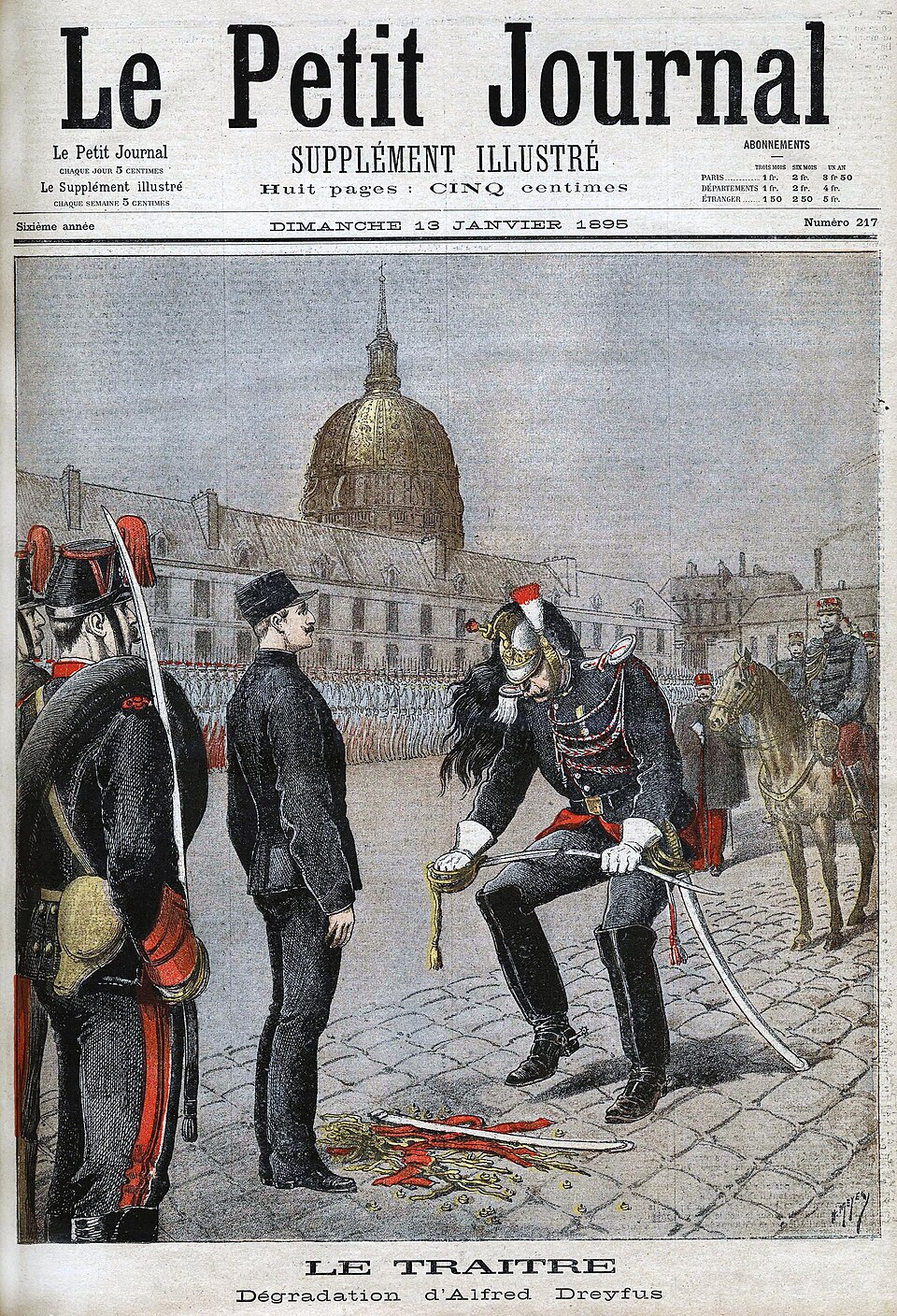
There is a moment near the beginning of the Dreyfus Affair that captures, with almost eerie precision, the logic of what was to come. On the morning of January 5th, 1895, Alfred Dreyfus was publicly degraded in the courtyard of the École militaire, his epaulettes torn from his shoulders, the red stripes ripped from his trousers, his sabre broken in two. As he was paraded before the crowd – still proclaiming his innocence – the novelist Maurice Barrès stood watching with the cool detachment of a connoisseur. It was, he wrote at the time, ‘a more exciting spectacle than the guillotine’. What he could not have known, and what makes his remark now so resonant, is that the spectacle was just beginning. The Affair would last another decade. France would nearly tear itself apart. And Barrès himself, the prince de la jeunesse (prince of youth), would become one of the engines of its destruction.
When I wrote The Man on Devil’s Island – published in Britain under that title and in America as Dreyfus: Politics, Emotion, and the Scandal of the Century – I was trying to understand how a miscarriage of justice involving an obscure army officer could have broken up families, triggered riots across the French empire, nearly toppled the Republic and occupied the greatest writers and philosophers of the age for the better part of a decade. The conventional answer – that it was a struggle between Enlightenment values and proto-fascist reaction, between democratic rationalism and clerical obscurantism – seemed to me then, and seems to me still more urgently now, to be inadequate. It is not wrong exactly. But it flattens the Affair into a morality tale, and morality tales, however comforting, are too pat to help in understanding forms of politics that overwhelm rational judgement and obscure ordinary political calculation.
Rereading the book now, I am struck by what I had intuited but failed fully to articulate at the time: the Dreyfus Affair was the first modern culture war. Not merely a political dispute in the conventional sense, not a conflict over policy or power alone, but a struggle in which the demonisation of opponents became so total that the rectification of even a plain injustice became impossible. This is what most resonates with the heightened emotional temperature of our current political debates.
A relatively contained injustice – the wrongful conviction of a Jewish officer on fabricated evidence – became the trigger for something far larger. Once the cover-up began, once the army closed ranks and the nationalist press mobilised, the Affair ceased to be about Alfred Dreyfus at all. It became, for the anti-Dreyfusards, a test of whether France would allow a ‘Jewish syndicate’ – as they imagined it – to subvert its military institutions in the name of a cosmopolitan individualism alien to the true spirit of the nation. For the Dreyfusards, it became a test of whether the Republic could survive the alliance of the Church, the army and an unscrupulous press. Neither side was fighting over a man’s guilt or innocence. They were fighting over the soul of France.
The culture war was animated by what can only be described as existential fear – and antisemitism was its most combustible fuel. The anti-Dreyfusards genuinely believed that France was in the grip of a conspiracy: that Jews, freemasons and Protestants had infiltrated the meritocratic institutions of the Republic and were systematically displacing the ‘true’ French from positions of power and influence. Édouard Drumont, the editor of La Libre Parole and the most influential antisemitic voice of the period, genuinely believed he was surrounded by diabolical forces; he even carried a mandrake root to ward off evil. His extraordinary, hallucinatory description of the Dreyfusard campaign as a witches’ sabbath, a ‘Walpurgis night’ of Jewish sorceresses and Protestant apostates, was not rhetoric in any ordinary sense; it was the expression of a man who experienced political opposition as supernatural threat, and a form of conspiratorial thinking that is all too present today. Antisemitism was not, in other words, a prejudice that the Affair happened to inflame. It was the organising principle of an entire world view, one in which Jews were at once all-powerful and irredeemably alien, the necessary enemy without whom the culture war could not be fought.
I remain convinced that the anti-Dreyfusards were not simply bad actors who knew their case was fraudulent and pressed it anyway, though some of them most certainly were. More interesting, and more frightening, is that they were unable to process evidence contrary to their convictions. When the forged documents at the heart of the prosecution were exposed – when Commandant Henry’s fabrications came to light and Henry himself committed suicide – the revelation only intensified the sense of siege. Henry was acclaimed as a patriotic martyr who had valiantly committed a single forgery to protect France. Supporters sent money to his widow, accompanied by messages of antisemitic hatred so intense — fantasies of evisceration, of Jewish bodies rendered into useful objects – that they remain shocking to read today. We are accustomed to finding such sentiments on the dark margins of political life. In France in 1898 they were expressed by magistrates, army officers and professors, and published in a national newspaper.
This is the mechanism at the heart of every culture war: the point at which evidence ceases to matter. Once a conflict has been framed in existential terms – once the other side is not merely mistaken but malevolent, not merely wrong but dangerous, not merely your opponent but your persecutor – then evidence becomes either ammunition or conspiracy, never instruction. The Dreyfusards understood this all too well. Even they – the rationalists, the champions of evidence and method – were not immune to it. Joseph Reinach, the most indefatigable chronicler of the Affair and a key Dreyfusard strategist, admitted that he had been convinced of Dreyfus’s innocence not by the evidence but simply because the Jesuits said he was guilty. The culture war colonised both sides.
What the Dreyfus Affair reveals, then, is not a clean struggle between reason and unreason but the ease with which a political conflict can be transformed into a war of allegiances in which there is no neutral ground. Once the miscarriage of justice was transformed into a behemoth of passion, it became almost impossible to resolve through ordinary political means. What strikes me now is not so much that the Affair offers lessons for our own moment – history rarely works so tidily – but that the structural conditions which produced it are so recognisably present: the transformation of political disputes into existential conflicts; the way in which evidence is processed through prior emotional commitments; the particular fury generated when people who once shared intellectual terrain and frequented the same institutions find themselves on opposite sides of an unbridgeable divide. The reader will not need to look far for contemporary examples.
****
The culture war produced, almost as a by-product, a term that would reshape the political vocabulary of the modern world. On February 1st, 1898, just before the opening of the trial of the novelist Émile Zola, who was being sued for defamation in connection with allegations that Dreyfus had been framed, Maurice Barrès published an article about the petition that many scholars and academics had signed in support of the captain. He made his position clear with characteristic insolence: the list of ‘intellectuals’, he wrote, consisted – ‘Jews and Protestants aside,’ – of ‘a majority of fatheads, and then of foreigners – and finally of only a few good Frenchmen’. The signatories were pontificators without authority, short-sighted cerebral men who had wrongly appointed themselves the moral arbiters of a nation they neither understood nor truly belonged to.
The word ‘intellectual’ was new, or nearly so. The radical republican journalist Georges Clemenceau had used it admiringly just days before, describing the scholars who had joined the Dreyfusard cause as a new social type defined not by birth or profession but by public commitment to reason and justice. Barrès seized on the term and turned it into an insult. Those he targeted did what the Impressionists had done with their own name a generation earlier: they adopted the insult and wore it as a badge. Within weeks, ‘intellectual’ had acquired the meaning it has never entirely lost.
What is striking is how precisely the anti-intellectual argument of the 1890s anticipates the anti-expert revolt of our own moment. The substance of the charge is almost identical: that a credentialled elite, elevated by a meritocratic system they themselves designed and control, has arrogated to itself the moral authority to instruct the rest of society; that this authority is a usurpation, not a legitimate inheritance; and that the values this elite promotes – universal reason, cosmopolitan solidarity, the rights of the individual against the claims of tradition – are not in fact universal but the specific cultural preferences of a specific social group in a specific period of time, dressed up in the language of merit and objectivity. One does not need to name the politicians who have made this argument in recent years; they will come readily enough to mind.
Ferdinand Brunetière, editor of the Revue des Deux Mondes, put the anti-Dreyfusard case with uncomfortable precision. A man of formidable erudition, elected to the Académie française in 1893, he asked why technical expertise in one field – philology, microbiology, medieval history – should confer authority to pronounce on moral or judicial questions. As Émile Duclaux, a Dreyfusard and a pioneering microbiologist, acknowledged, science was not Truth, but contingent, subject to change and progression, producing findings that might be obsolete in a decade. In arguing against its claims, Brunetière was not taking up an anti-rational position. His was an argument about legitimacy: who has the right to speak, and on what basis? His answer – which carried enormous resonance – was that the intellectuals had no such right, or at least no more than anyone else, and that their pretension to moral authority was the pretension of a class, not a principle.
The letters that flooded in congratulating him showed exactly where that resonance came from. A constitutional jurist condemned ‘proud spirits who want to admit neither discipline nor authority’. A seminary student reported that Brunetière’s polemics ‘circulated here from cell to cell’ as a clandestine manifesto for Catholics struggling against Republican cultural hegemony. A simple correspondent complained that the intellectuals ‘served only as reserve officers’, unwilling to assume the same duties as ‘the simple worker or the modest peasant’. What united these men was not a coherent political programme but a shared feeling: that a self-appointed clerisy had captured the institutions of the Republic and was using them to instruct, exclude and condescend.
The charge was not entirely without foundation, which is what makes it so difficult to dismiss then or now. The Dreyfusard intellectuals were an elite. They did share a specific cultural formation – the grandes écoles, the positivist faith in reason and method, the salons of the liberal Republic – largely unavailable to most Frenchmen. Émile Durkheim, who became the movement’s most important theoretical voice, was quite candid about his own project: to use the authority of the schoolmaster as a kind of secular priesthood, instilling republican values in the young with what he himself compared to the suggestive power of a hypnotist over his subject. The schoolteacher, in Durkheim’s vision, was ‘the secular successor to the priest’, and his authority, like the priest’s, was not to be questioned. Barrès and Brunetière saw in this precisely what they said they saw: not reason, but the will to power dressed in academic robes.
The most illuminating single moment in all of this was the encounter between Léon Blum and Barrès in the early days of the campaign, when the younger man asked that Barrès sign a petition so that Dreyfus could be retried. Blum, a future socialist prime minister then in his twenties, approached Barrès with complete confidence that the novelist would sign. Blum admired him enormously, shared his contempt for the corrupt parliamentary republic, and genuinely could not imagine that the prince de la jeunesse – the chronicler of the free individual’s revolt against convention – would side with military authority over a man’s proven innocence. But Barrès did decline, and within days published his denunciation of the ‘fatheads’.
Blum’s bewilderment is poignant and revealing. He had read Barrès’s early novels as a libertarian manifesto. What he had not grasped was that Barrès’s individualism had always been the individualism of a specific kind of Frenchman – rooted in soil, blood, the ancestral memory of Lorraine – and not the abstract universal individual of the Enlightenment tradition – and certainly not Jews like Dreyfus. The ‘free man’ of Barrès’s early fiction was free within his inheritance, not free from it. The encounter encapsulates what was perhaps the culture war’s most corrosive dynamic: the moment when former inhabitants of the same intellectual and moral universe discover that they never, in fact, shared the same premises at all.
The Affair, in this reading, was the moment when the French Republic’s founding ambiguity was exposed and weaponised. The intellectuals were right about Dreyfus. They were right about the forgeries, the cover-up, the conspiracy. But they were also, in important ways, blind to the degree to which their claim to speak for universal reason was experienced by much of France as the claim of a conquering caste. That blindness had consequences. And those consequences are still, in various transmutations, being worked out.
****
There is a moment near the very end of the Affair that has always struck me as among its most revealing. In the summer of 1906, Alfred Dreyfus was, finally, formally exonerated. He received the Légion d’honneur and was reintegrated into the army. He shook hands with Georges Picquart, the army intelligence officer who discovered that Ferdinand Walsin Esterhazy, not Dreyfus, was the real spy. This public exoneration took place in the École militaire – the very place where he had been publicly degraded eleven years before. It should have been a moment of unambiguous triumph. Instead, it was shadowed by a final, almost gratuitous insult: Picquart was promoted to general; Dreyfus, whose years on Devil’s Island were not counted towards his seniority, was left a commandant, junior to officers promoted six and seven years after him. He resigned from the army on Bastille Day 1907. ‘I had hoped,’ he wrote, ‘that the solemn proclamation of my innocence would put an end to my trials. Not a bit of it; I had to stay the victim until the end.’
It is a sentence worth contemplating, for it describes not only a personal disappointment but a structural reality: political conflicts of this kind rarely conclude cleanly or justly, and the original victim is almost always left holding the residue of a crisis he did not create.
The conventional narrative of the Affair ends with the rehabilitation and treats it as vindication: truth triumphed, justice prevailed, the Republic held. The Man on Devil’s Island, read again now, tells a darker story. What the aftermath reveals is the extraordinary difficulty of achieving genuine accountability and closure in the wake of such conflict, and the way in which the attempt to impose them can itself become a form of persecution, widening rather than healing the breach between the two sides.
The pardon of September 1899, the act that freed Dreyfus from Rennes prison, was not – as prime minister Pierre Waldeck-Rousseau’s war minister cheerfully announced – an acknowledgement of innocence. It was a gesture of compassion toward a suffering man, extended without prejudice to the question of guilt. The conspirators were meanwhile granted a comprehensive amnesty protecting them from prosecution. Dreyfus protested with controlled fury: the amnesty, he said, ‘hits me in my heart; it was made for General Mercier’s exclusive advantage’. And then, with a shamelessness that still takes the breath away, Mercier – who had presided over the fabrication of evidence and continued to assert Dreyfus’s guilt long after that position had become indefensible – was elected to the senate of the French Republic, where he served until 1920. Waldeck-Rousseau was not a villain; he was a capable statesman who understood that ending a political crisis is rarely the same as achieving the moral settlement true justice would require. The amnesty was the price of social peace. It is a price that victims of such settlements have been paying ever since.
Unable to prosecute the conspirators, unwilling to accept the amnesty’s implications, the Dreyfusard victors turned their energy toward the institutions that had sheltered and enabled the anti-Dreyfusard movement, the Church above all. What followed was a campaign of considerable ferocity against religious congregations, with schools closed, orders expelled and priests subjected to surveillance. The impulse was understandable. But the ferocity of the campaign ensured that the wound the Affair had opened did not close. It gave the defeated a story of victimhood and persecution that nourished resentment for decades – resentment that resurfaced in the 1930s, in Vichy, in the long poisonous tradition of French antisemitism that the end of the Affair did not destroy but merely, temporarily, drove underground.
The disintegration of the Dreyfusard coalition itself is equally instructive. Mathieu Dreyfus, reflecting on the aftermath in 1901, put it with quiet precision: when men throw themselves into passionate action, he wrote, their motives are ‘varied and not always distinguishable – justice, truth, the love of struggle, the search for glory, the need for an ideal’. These sentiments act upon men’s consciences without their being able to recognise exactly what motives they are obeying. After the campaign comes ‘the return to normal life, with its pettiness, needs, and necessities. We become what we were: complicated machines, animated by good and bad sentiments.’ It is one of the most honest things written about political activism that I have encountered, and it applies well beyond the Affair.
What Mathieu was describing was the slow revelation, in the deflating aftermath of mutilated victory, of everything that the common struggle had concealed. The great Dreyfusard coalition had been held together by a single, morally legible goal. Once that goal was partially achieved, the differences that had been subordinated to the shared cause came flooding back. Old friends accused Dreyfus of cowardice when he retreated to Switzerland to recover his health. The men and women who had once worshipped him as a martyr began, almost imperceptibly, to resent him for failing to be the hero the myth required. The coalition lost the emotional fuel it ran on, and without that fuel all the tensions that had always been present – personal rivalries, conflicting visions of what the Affair had meant – came to the surface.
Yet the most remarkable figure in this unravelling, and the one my book keeps returning to, is Dreyfus himself. He had more reason than anyone to demand vengeance and consistently declined to do so – not out of weakness but out of a clear-eyed understanding that his own dignity and his country’s future required something other than an endless reckoning. ‘I console myself,’ he wrote, ‘in thinking that the iniquity which I have so prodigiously suffered has served the cause of humanity and developed feelings of social solidarity.’ It is a remarkable sentence from a man who had been chained to a bed in the tropics, whose teeth had rotted from his diet of scraps and rancid pork, who had barely survived to be exonerated – and who was then denied the military rank his service had earned.
His refusal to make victimhood a permanent identity, his insistence on the value of what had been achieved rather than on what remained undone, strike me as politically and morally more sophisticated than the positions of those around him who demanded more. It does not resolve the question of accountability. But it offers something that neither the amnesty nor the anticlerical purge could provide: a way of living in the world after the crisis without being consumed by it. The Affair was managed, in the end, without grace – by a pardon that was not quite forgiveness, an amnesty that was not quite reconciliation, a rehabilitation that came too late and too partially to satisfy anyone. The bitterness it generated lasted for generations. The question of how a society emerges from a culture war without either suppressing the demand for justice or allowing that demand to become its own form of persecution remains, as we may soon realise ourselves, one that has no easy answer.
Donate ← Back to the current issue